Start of the Six-Day War
Middle East
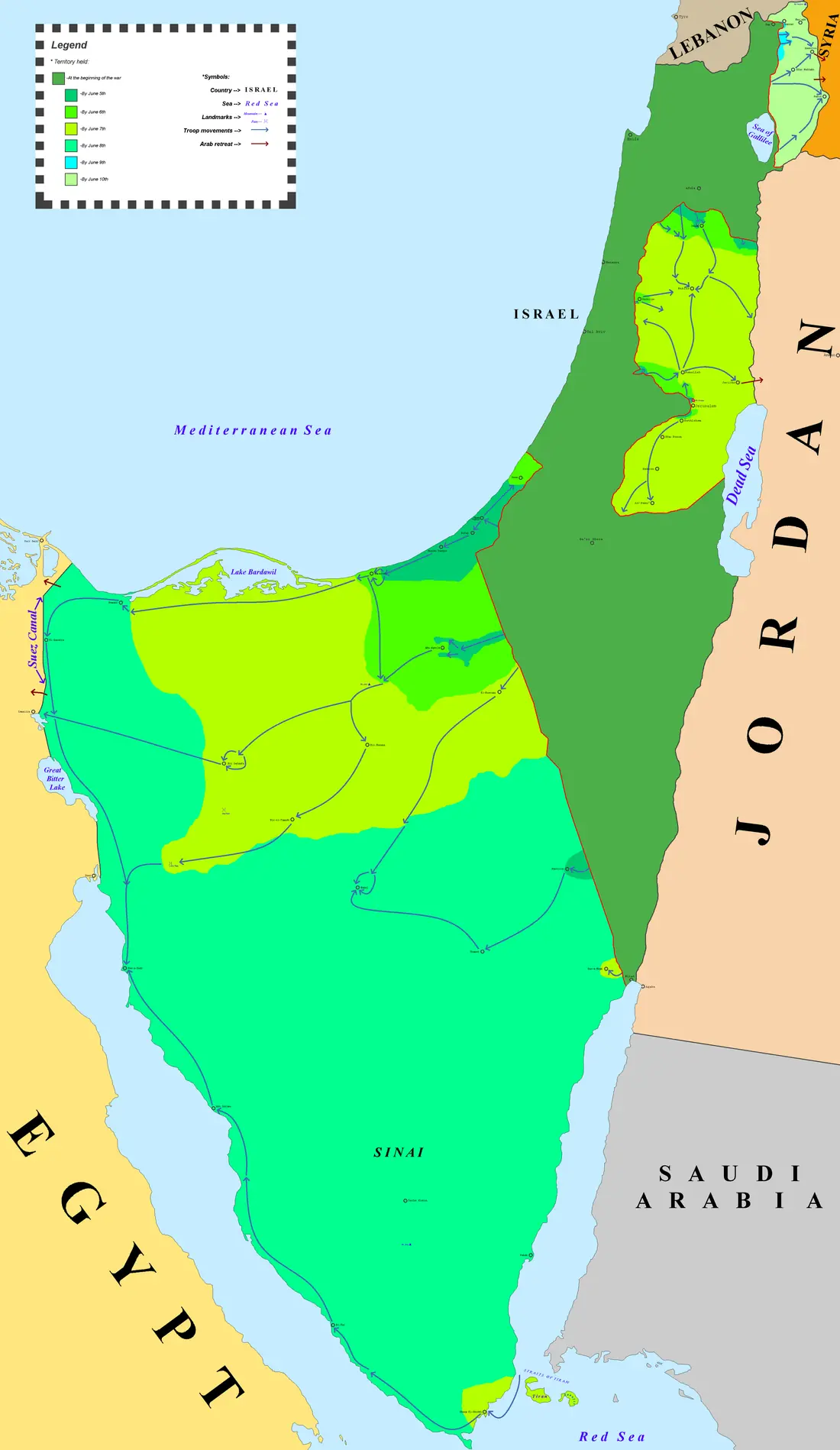
In the blistering desert dawn of June 1967, Israeli jets scream towards Egyptian airfields, their missiles locked onto targets with deadly precision. The surprise attack, code-named Operation Focus, is the spark that sets off the Six-Day War, a conflict that will redraw the map of the Middle East and leave deep scars that still linger today.
The war is sparked by a complex web of tensions between Israel and its Arab neighbors, with Egypt, Jordan, and Syria forming a united front against the fledgling Jewish state. As Egyptian President Gamal Abdel Nasser blockades the Straits of Tiran, choking off Israel's access to the Red Sea, the Israeli government knows it must act fast to prevent economic strangulation. The result is a bold, high-stakes gamble: a preemptive strike that will either secure Israel's future or plunge the region into chaos.
As the war rages on, the Israeli military achieves a stunning series of victories, capturing the Gaza Strip and the Sinai Peninsula from Egypt, the West Bank from Jordan, and the Golan Heights from Syria. The numbers are staggering: over 15,000 Arab soldiers are killed or wounded, compared to just 700 Israeli casualties. The war also creates a massive refugee crisis, with over 300,000 Palestinians fleeing their homes in the West Bank and Gaza. For the first time, Israel finds itself in control of the holy city of Jerusalem, a development that will have far-reaching consequences for the Jewish state and the wider world.
One of the most surprising aspects of the war is the role played by the Soviet Union, which provides significant military and economic aid to the Arab states. The Soviets see the conflict as a key battleground in the Cold War, with the United States backing Israel. The CIA estimates that the Soviets provide over $2 billion in military aid to the Arab states during the war, a staggering sum that helps to fuel the conflict. As the war ends, the United Nations Security Council passes Resolution 242, calling for Israel to withdraw from the territories it has occupied in exchange for a comprehensive peace treaty. However, the resolution is deliberately vague, leaving room for interpretation and setting the stage for decades of diplomatic wrangling.
As the years go by, the consequences of the Six-Day War continue to reverberate. The Israeli occupation of the West Bank and Gaza creates a festering wound, with Palestinians living under military rule and facing severe restrictions on their movement and economic activity. The war also sets the stage for the rise of Palestinian nationalism, with groups like the Palestine Liberation Organization (PLO) emerging to challenge Israeli rule. In 1987, the First Intifada breaks out, a wave of mass protests and violence that will last for six years and claim over 1,000 lives. The intifada is sparked by years of frustration and desperation among Palestinians, who feel that their rights and freedoms are being systematically denied.
Today, the legacy of the Six-Day War remains deeply contested. For Israelis, the war is a triumphant moment of self-defense, a testament to the bravery and ingenuity of the Israeli military. For Palestinians, it is a catastrophic event that has condemned them to decades of occupation and dispossession. As the conflict continues to simmer, with periodic outbreaks of violence and diplomacy, one image stands out: the separation barrier that now divides Israel from the West Bank, a stark reminder of the war's enduring impact on the lives of millions of people. The barrier, which stretches for over 400 miles, is a potent symbol of the divisions and tensions that remain, a physical manifestation of the conflict's deep-seated roots.