
Six-Day War: Israel captures the Gaza Strip
Gaza Strip, Palestine
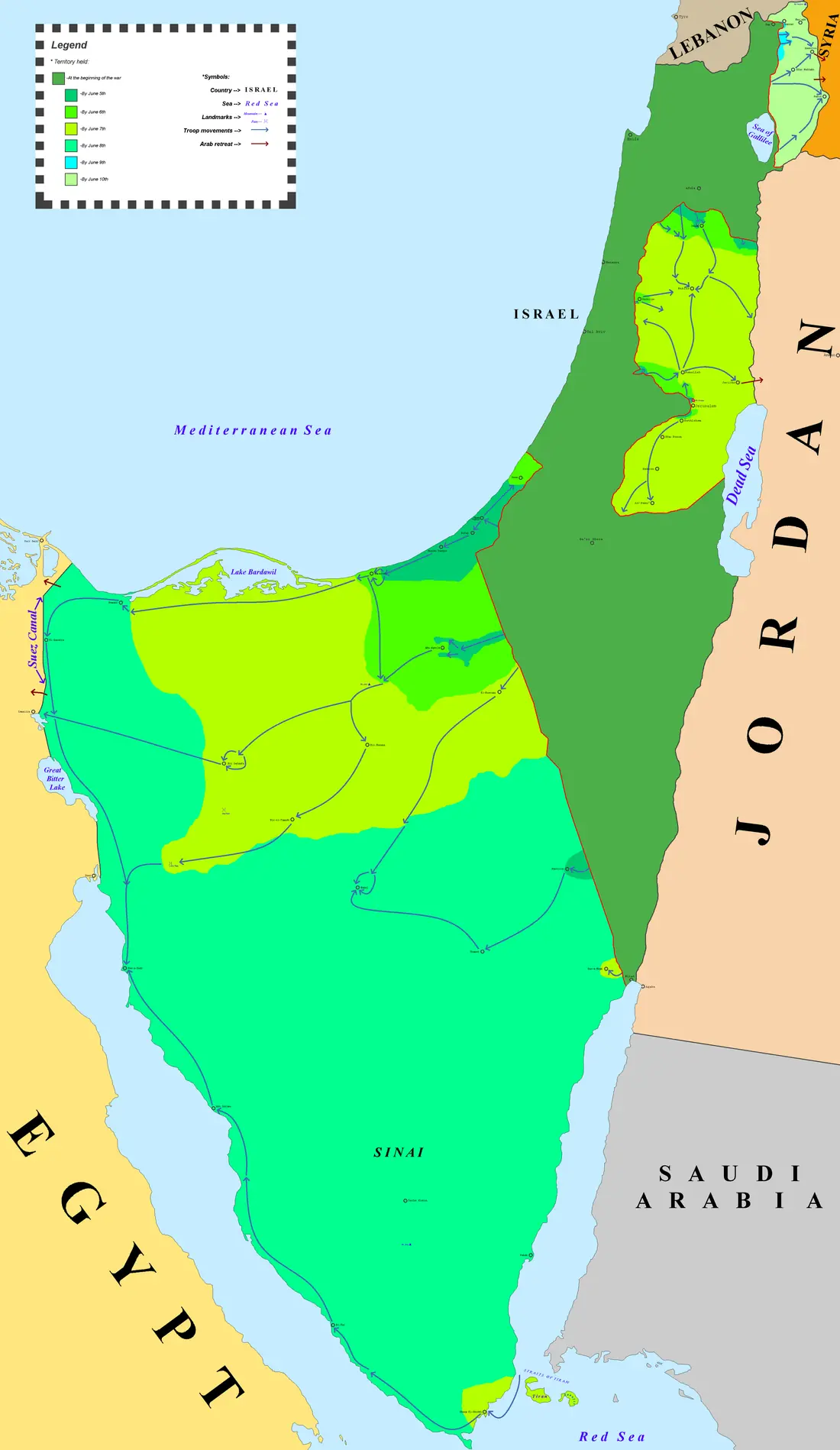
As Egyptian forces retreated from the Gaza Strip, a young Palestinian girl named Amal Abu Shanab, just 12 years old, watched in awe as Israeli tanks rolled into her neighborhood, their cannons still smoking from the intense battle that had raged on for days. The year was 1967, and the Six-Day War was nearing its end, with Israel having already captured the Sinai Peninsula and the West Bank. The Gaza Strip, a small coastal region with a population of around 350,000 Palestinians, was the last remaining stronghold of Egyptian forces in the area.
The war had begun on June 5, 1967, when Israel launched a surprise attack on Egyptian airfields, destroying nearly 90% of the country's air force. The attack was a masterstroke, giving Israel a significant advantage in the skies and allowing its ground forces to push deep into Egyptian territory. As the Israeli army advanced, it encountered fierce resistance from Egyptian troops, but ultimately, the Israelis emerged victorious, capturing the Gaza Strip on June 7, 1967.
The capture of the Gaza Strip was a pivotal moment in the war, as it gave Israel control over a strategic piece of land that bordered both Egypt and the Mediterranean Sea. The Israeli military had used a combination of air power, artillery, and infantry to overwhelm the Egyptian defenses, and by the time they entered the Gaza Strip, the Egyptians were in full retreat. As Amal Abu Shanab watched, Israeli soldiers began to take control of key installations, including the city's main hospital, where they found evidence of the intense fighting that had taken place in the preceding days.
One of the most surprising aspects of the war was the role played by Israeli military strategist, General Yitzhak Rabin, who had planned the campaign with meticulous care. Rabin, a former commander of the Israeli army's elite paratrooper unit, had used his knowledge of the Egyptian military to outmaneuver them at every turn, striking at their weak points and exploiting their mistakes. As the war drew to a close, Rabin's plan had proven to be a resounding success, with Israel having captured large swathes of territory from its Arab neighbors.
The human cost of the war, however, was significant, with over 15,000 Egyptian soldiers killed or wounded, and around 1,000 Israeli troops lost. The Gaza Strip, in particular, had been heavily bombed, with many buildings reduced to rubble and civilians caught in the crossfire. As Amal Abu Shanab navigated the ruins of her neighborhood, she saw the devastating impact of the war firsthand, with families left homeless and without access to basic necessities like food and water.
As the dust settled on the Gaza Strip, the Israeli military began to establish a new administration, with General Mordechai Gur, a seasoned officer, appointed as the region's military governor. Gur's task was to restore order and provide humanitarian aid to the local population, but it was a daunting challenge, given the scale of the destruction and the deep-seated animosity between Israelis and Palestinians. As Amal Abu Shanab looked on, she wondered what the future held for her family and her community, now under Israeli occupation.
The legacy of the Six-Day War continues to shape the Middle East to this day, with the conflict over the Gaza Strip remaining a major point of contention between Israelis and Palestinians. As Amal Abu Shanab grew older, she became a vocal advocate for Palestinian rights, using her experiences during the war to inform her activism and push for a more just and equitable solution to the conflict. And as she looked back on those fateful days in June 1967, she remembered the fear, the chaos, and the uncertainty, but also the resilience and the determination of her people, who continued to struggle for freedom and self-determination in the face of overwhelming odds.