
Daily History
Science & discovery

Mariner 4 Sends First Close-Up Mars Images to Earth
Mariner 4 Sends First Close-Up Mars Images to Earth
Image: NASA · Public domain

The photograph arrived as a disappointment disguised as triumph.

On July 14, 1965, the Mariner 4 spacecraft swung past Mars at a distance of 5,600 miles and sent back 22 grainy black-and-white images. For the first time in human history, we saw another planet up close. What we saw was: craters. Lots of them. A dead, pocked surface that looked, as one NASA scientist put it, like the Moon's less interesting cousin.

This was supposed to be exhilarating. It was supposed to be vindication. Instead, it felt like standing in front of a door you'd been pounding on for years, finally getting it open, and finding an empty room.

The disappointment, though, is the real story—because it tells you everything about what we'd actually been hoping for.
Mariner 4 Sends First Close-Up Mars Images to Earth
Image: NASA · Public domain

For decades, Mars had lived in the American imagination as a frontier of possibility. Astronomers had spotted what looked like canals crisscrossing the Martian surface. The Italian astronomer Giovanni Schiaparelli had named them "canali" in 1877, and the term mutated in translation and in the American popular mind into something far more suggestive: evidence of engineering. Evidence of life. By the early 1960s, most serious astronomers knew the canals were optical illusions—tricks of atmospheric distortion and human pattern-recognition gone haywire. But the public didn't know it. Mars was still the place where civilizations might exist, where we might find answers to the fundamental question: Are we alone?

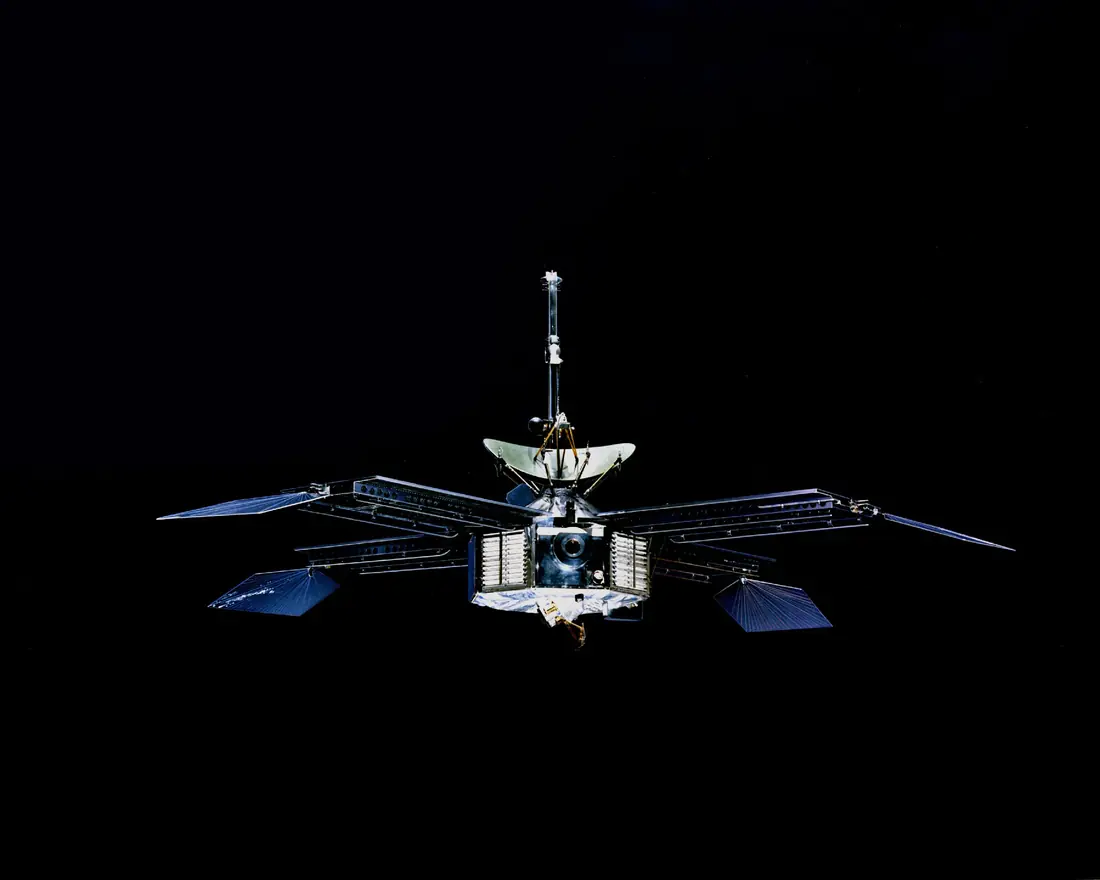
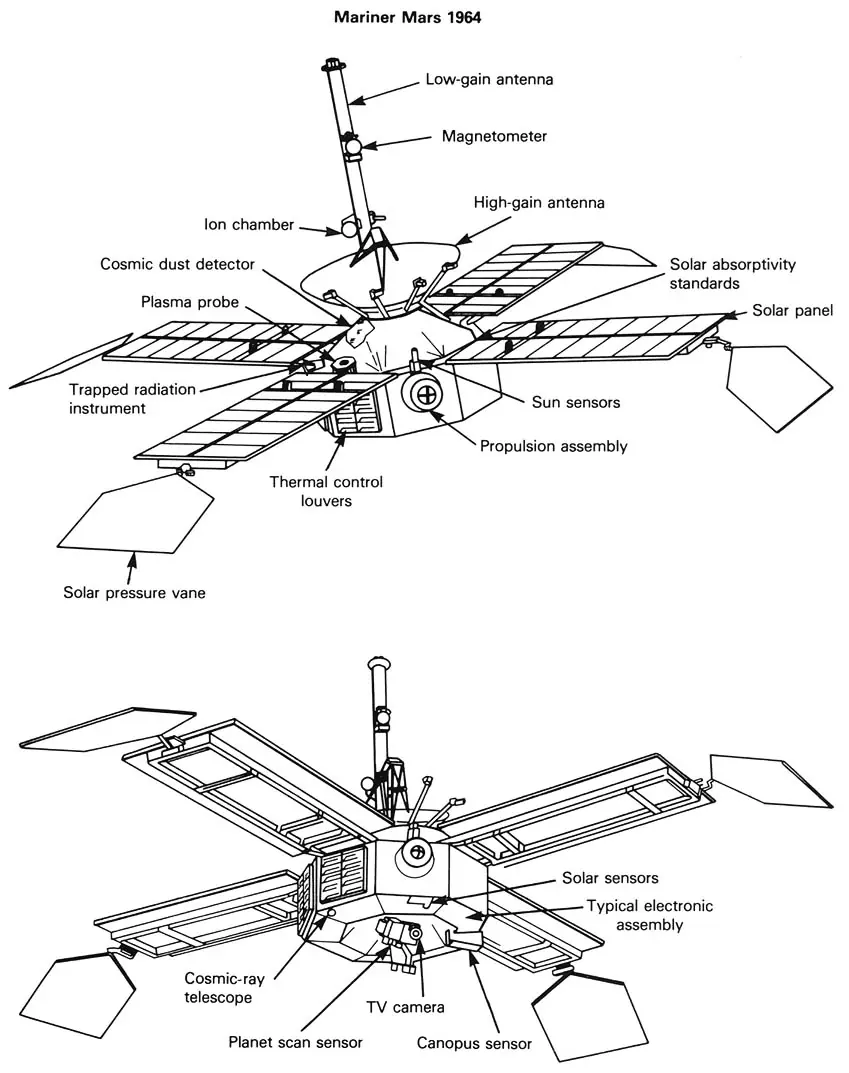
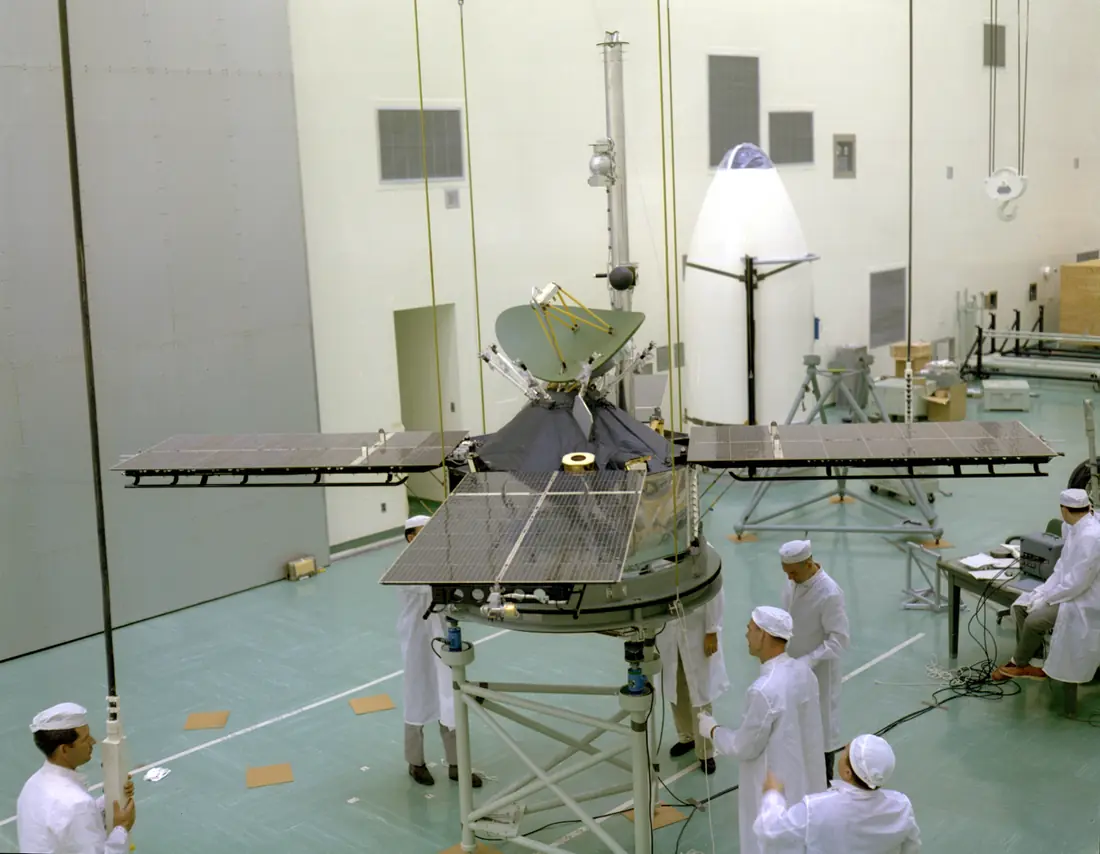
Mariner 4 was designed to answer that question. The spacecraft was the size of a station wagon, cost $83 million (roughly $750 million today), and carried instruments so sensitive they could detect radiation and measure the Martian atmosphere. Its camera system was primitive by any standard—the resolution was terrible, the images came back at a glacial pace, transmitted as radio signals that had to travel 134 million miles through space. The data rate was so slow that the first photograph took eight hours to arrive, pixel by pixel, assembled like a puzzle by patient technicians.

When those images finally appeared, they showed something the scientists hadn't quite expected: a world that looked hostile to life. No atmosphere to speak of. No magnetic field to shield against solar radiation. Craters everywhere, suggesting a geologically dead place, bombarded for billions of years with nothing to show for it but scars.
Mariner 4 Sends First Close-Up Mars Images to Earth
Image: NASA/JPL · Public domain

It was crushing. Not because the science was bad—the science was impeccable—but because it meant revising the story we'd been telling ourselves. Mars wasn't a world of possibilities. It was a world of endings.

Yet here's what makes this genuinely interesting: the disappointment was productive. Those 22 grainy photographs killed one dream and made room for another. Scientists stopped looking for Martian civilizations and started asking harder questions: Could microbial life survive underground? Could life have existed billions of years ago, when Mars had liquid water? The focus shifted from what we hoped to find to what might actually be findable.

Mariner 4's real discovery wasn't what it showed. It was what it made us stop believing in—and what we started believing in instead. We'd finally looked at Mars directly, and we'd finally begun to see it as it actually was. That's not the same as finding paradise. But it's the beginning of understanding.

Source: en.wikipedia.org/wiki/Mariner 4

Technology

France Joins the Nuclear Club with First H-Bomb Test

Mururoa Atoll, French Polynesia

Charles de Gaulle wanted France to matter again, and on July 14, 1966, in the middle of the Pacific Ocean, he proved it could destroy the world just as effectively as anyone else.

At 6:00 a.m. on Mururoa Atoll, a French thermonuclear device detonated with a yield of about 2.6 megatons—roughly 170 times the power of the Hiroshima bomb. The blast turned the lagoon into a churning inferno and sent a mushroom cloud 40,000 feet into the air. France was now officially a nuclear power, the fourth nation on Earth to join the club, and it had done so with a kind of defiant grace that only the French could manage: the test happened on Bastille Day, their independence day, as if to say *we do what we want, when we want, where we want*.

What made this moment genuinely consequential wasn't the explosion itself—the world had seen plenty of those. It was everything that came after.

France had been conducting nuclear tests in the Sahara since 1960, but the Sahara was home to people. By 1966, the Algerian government was making noise about the radioactive contamination, and de Gaulle needed a place where France could test without anyone who mattered complaining. Enter French Polynesia: a collection of Pacific islands where France held colonial authority and the population was small enough that their objections could be safely ignored. Over the next three decades, France would detonate 193 nuclear devices at Mururoa and nearby Fangataufa—more than the Soviet Union tested in the same period, and all of it in someone else's backyard.

The consequences arrived slowly and then all at once. Radiation leaked into the lagoon and the surrounding ocean. Thyroid cancer rates in French Polynesia climbed to levels that would trigger international incidents anywhere else. Fish became unsafe to eat. Coral reefs died. The Polynesian people—who had no say in whether the tests happened—bore the physical cost while France gained the geopolitical prize of being a genuine nuclear power.

For decades, France denied the health impacts. Official reports downplayed contamination. Islanders who got sick were treated as inconvenient casualties of progress. It wasn't until 2009—43 years later—that France acknowledged any connection between the tests and cancer rates. Even then, compensation was minimal and grudging. Many of those who had lived through the testing period never received acknowledgment, let alone restitution.

The real irony cuts deep: France tested these weapons in the Pacific partly to avoid contaminating French soil, which meant contaminating someone else's soil instead. The strategic calculation was simple. The moral one was easier to ignore when the people affected had no political leverage and lived 10,000 miles away.

Today, Mururoa Atoll is sealed off, still too radioactive for habitation. The lagoon remains contaminated. France stopped testing in 1996 and signed the Comprehensive Nuclear-Test-Ban Treaty the same year, finally joining the club of nations that claimed to want nuclear disarmament. The irony of that timing is almost too clean: once you've built your bomb, you can afford to be principled about everyone else building theirs.

Source: en.wikipedia.org/wiki/Operation Dominique

Use the arrow keys to move between days

Browse the full archive →