The Higgs Boson Confirmed
Geneva, Switzerland
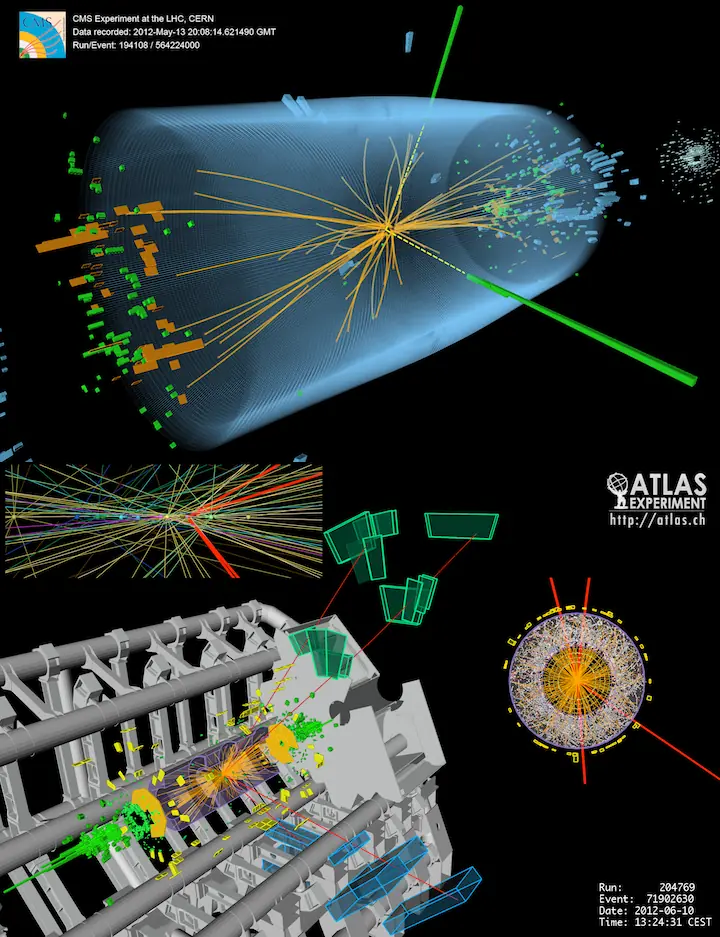
Peter Higgs sat in a Geneva auditorium on July 4, 2012, and watched physicists announce they'd found the thing he'd predicted in 1964—and he was not allowed to tell anyone beforehand. The embargo was absolute. For months, one of the most important predictions in twentieth-century physics hung in the balance, and the person who'd staked his career on it had to keep quiet like everyone else.
When they showed the data—two independent experiments, 10 million particle collisions per second, five years of searching through noise—the room erupted. Higgs wept. He had spent nearly fifty years waiting for this moment, and he almost didn't live to see it.
Here's what almost no one talked about afterward: finding the Higgs boson was, in the most important sense, anticlimactic. The Standard Model had predicted it would be there. Physicists built a 17-mile tunnel beneath the Swiss-French border, cost $9 billion, employed ten thousand people across dozens of nations, and confirmed something they were already 99.9 percent certain about. It was the most expensive validation in human history.
But that was precisely why it mattered so much—and why its true consequences unfolded quietly, over years, in places the public never saw.
The discovery didn't change the power grid or cure disease or land rovers on Mars. It didn't immediately enable anything. What it did was slam a door shut. For forty years, physicists had whispered about the one thing missing from their model of reality. The Higgs was the final piece. Once they found it, they couldn't pretend anymore that they were close to understanding everything. They were, in fact, nowhere close. Dark matter still accounted for 85 percent of the universe's mass and remained invisible. Dark energy was even more mysterious. The Standard Model was complete—and demonstrably incomplete.
This realization rippled outward with uncomfortable force. Funding committees had to confront a question they'd been avoiding: Why spend billions to confirm a theory only to learn your theory can't explain the universe? The answer, it turned out, was complicated. In the decade after 2012, particle physics funding in the United States flatlined. CERN's plans for bigger machines stalled. The implicit promise—that smashing particles harder and faster would reveal nature's secrets—looked less certain.
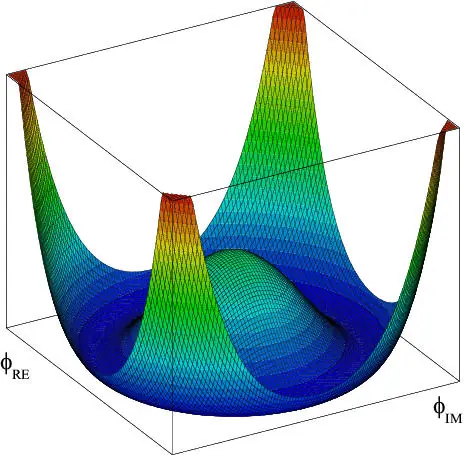
Yet something stranger happened inside the field itself. The Higgs confirmed that the universe's particles acquire mass through interaction with an invisible field pervading all of space. This wasn't a discovery that ended curiosity; it redirected it. Physicists pivoted toward questions that actually mattered: Why does the Higgs field have the value it does? Why is it so light compared to other forces? Could there be other Higgs bosons we haven't found?
Meanwhile, in the labs and offices scattered across the globe, careers that had staked everything on that one day moved forward. Graduate students who'd started their dissertations on the assumption the Higgs existed suddenly had data. Some became celebrated theorists. Others quietly moved into applied fields—banking, AI, climate modeling. They'd learned to think like particle physicists: patient, precise, comfortable with uncertainty.
Peter Higgs died in April 2024, aged 94. By then, the Higgs boson was old news, textbook material. Physics had moved on to hunting for something less predictable, less reassuring. The triumph of 2012 was complete. It had closed one chapter and opened a much longer, messier one that we're still writing.