
Daily History
Politics & state

Potsdam Conference Reshapes Post-War World

Potsdam, Germany
Potsdam Conference Reshapes Post-War World — Potsdam, Germany
Image: Unknown official photographer · Public domain

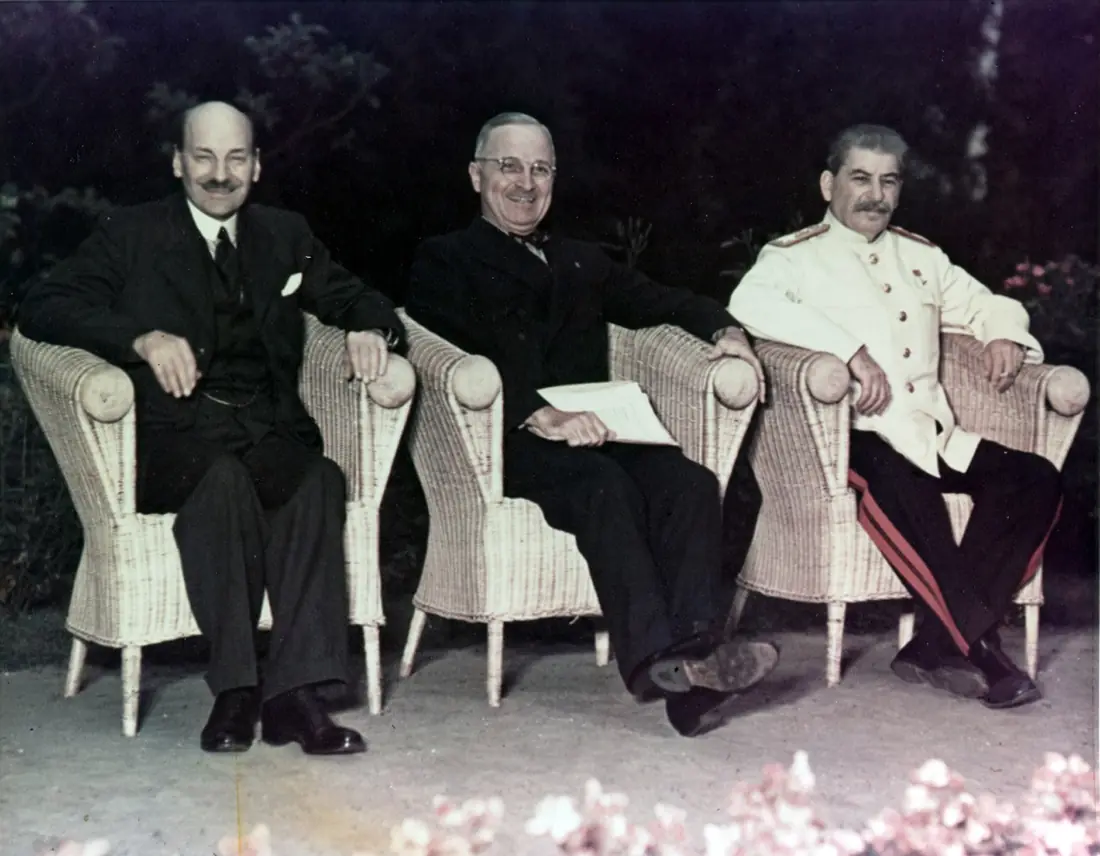
Churchill arrived in Potsdam wearing a bow tie the color of dried blood, and within hours, the world's power structure began to crack.

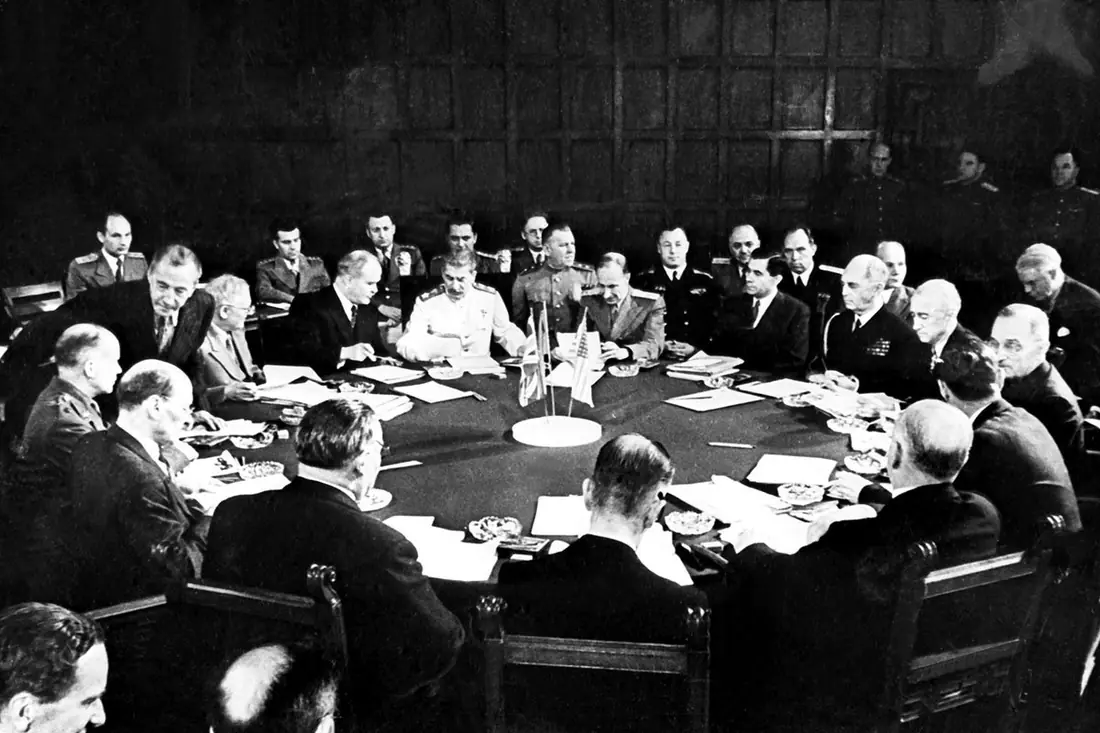
It was July 17, 1945. The war in Europe had been over for two months. Japan was still fighting, though everyone knew it wouldn't last much longer—the atomic bomb had been tested in the New Mexico desert just three weeks earlier, and both Truman and Stalin knew about it, though neither said so aloud. Now the three men who had won the war sat down in a German palace to divide what remained.

Potsdam was a deliberate choice. The city lay in the Soviet zone of occupation, which meant Stalin had home advantage and didn't need to travel. It also meant something else, something that would echo across the next seventy years: the conference happened on conquered German soil, in a country that no longer existed as a political entity. The Allies had agreed to unconditional surrender. There was no German government to negotiate with, no seat at the table. What happened in Potsdam would be written into law by the victors alone.
Potsdam Conference Reshapes Post-War World — Potsdam, Germany
Image: UnknownUnknown · CC BY-SA 3.0 de

The three leaders were not equals, though they pretended otherwise. Truman had been president for exactly ninety-seven days. He was fifty-eight and had never met Stalin or Churchill in person. He arrived carrying the weight of a decision not yet made: whether to use the atomic bomb on Japan. Stalin was sixty-six, hard as granite, and had spent the entire war fighting on his own soil while Americans and British fought overseas. Churchill was seventy, brilliant, and already watching Stalin's armies settle into Eastern Europe like a man watching his house burn while the fire chief stands in the doorway. The British election had just happened; Churchill would learn mid-conference that he'd lost power and would be replaced by Clement Attlee. He kept the news to himself for a day.

What they decided was this: Germany would be split into four occupation zones. The Soviet Union would get a massive slice of Eastern European territory, including parts of Poland. Poland itself would shift westward, gaining German land and losing Soviet land, as if the whole continent were a puzzle being solved by moving the pieces around. Germany would pay reparations in goods and labor. The details were vague—intentionally so. When you're dividing the spoils of a war that killed 70 million people, precision can be dangerous.
Potsdam Conference Reshapes Post-War World — Potsdam, Germany
Image: Series: Photographs Relating to the Administration, Family, and Personal Life of Harry S. Truman, 1957 - 2004 Collection · Public domain

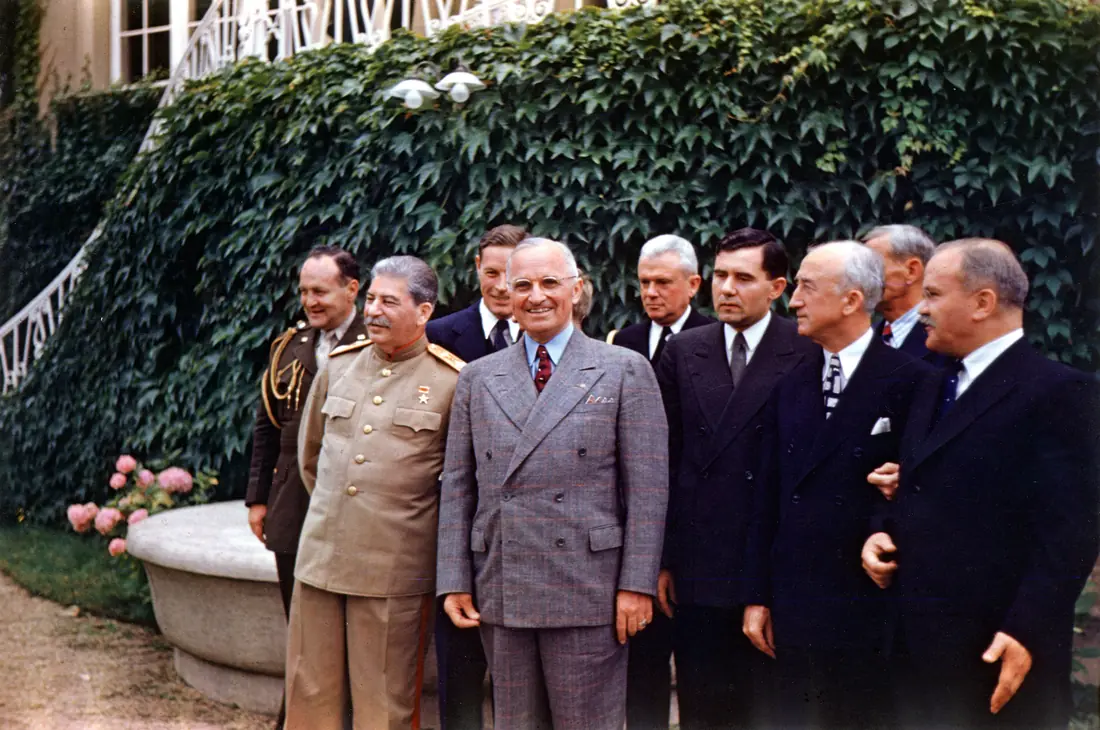
But here's what changed: before Potsdam, the idea of a world carved up by three great powers was still theoretical. After it, that world became real. The Allies had promised each other at Tehran and Yalta that they would stay united in peace as they had in war. At Potsdam, that promise died quietly. Stalin left with Eastern Europe in his pocket. Truman left knowing he could use nuclear weapons. Churchill left knowing he'd already lost the peace.

Within three years, Churchill would give a speech in Missouri about an "iron curtain" descending across Europe. Within five years, the Soviet Union would have the bomb too. The world that emerged from Potsdam wasn't the one anyone had planned for. It was the one Stalin had always wanted.

The conference lasted two weeks. In that time, the future hardened into place.

Source: en.wikipedia.org/wiki/Potsdam Conference

War & conflict

Tsar Nicholas II and Family Executed, Romanov Dynasty Ends

Yekaterinburg, Russia

A basement room in Yekaterinburg. Midnight, July 16th into the 17th, 1918. Eleven people—a Tsar, his wife, five children, a doctor, a valet, a cook, a chambermaid—are told to wait while the house is prepared. They descend the stairs. The door locks. Twelve minutes later, the door opens again. Everyone inside is dead.

Nicholas II had been many things: an autocrat, a reluctant modernizer, a man who believed God had personally handed him Russia. What he was not, by 1918, was necessary. The Russian Revolution had devoured him whole, and the Bolsheviks—now locked in a civil war against the White armies who wanted the Romanovs restored—made a calculation that was perfectly logical and perfectly ruthless. Dead tsars cannot become rallying points. Dead tsars cannot escape and lead counterrevolutions. Dead tsars are simply dead.

But here is what nobody anticipated: the execution didn't end the Romanov story. It weaponized it.

For decades after, the rumor persisted that one of the children had survived. Anastasia, the youngest daughter, supposedly escaped the basement. She lived in hiding. She was spotted in Berlin, in America, in Argentina. A woman named Anna Anderson claimed to be her, and her case dragged through German courts for thirty years, collecting believers like a magnet collects iron filings. People *wanted* Anastasia to be alive. A lone survivor was a redemption story; a basement full of bullets was just a basement full of bullets. The myth was more useful than the truth.

It took DNA testing in 1994—seventy-six years later—to prove what had actually happened. All five children died that night. No survivors. The story people had been telling themselves for three-quarters of a century was a beautiful, elaborate lie.

But the real consequence wasn't the death itself. It was what came after in the minds of millions. The execution created a martyr narrative that the Bolsheviks desperately didn't want. Russian émigrés spread the story of the noble family murdered in darkness. Monarchists abroad held memorials. The Orthodox Church canonized them as saints in 2000. A family that had ruled through divine right became, in death, a symbol of innocent suffering—which is infinitely more powerful than a symbol of political authority.

The Bolsheviks won the civil war anyway. The White armies failed. The Soviet Union lasted seventy-three years. And yet, Nicholas and Alexandra and their children—stripped of power, executed in secret, their bodies dumped in a mineshaft and burned—somehow outlasted the ideology that killed them. They became the ghosts that haunted the Soviet system from the inside, proof that even total victory tastes like ash if you have to execute children to achieve it.

The basement in Yekaterinburg still stands. It's a museum now. Tourists file through the room where eleven people died in twelve minutes, and they leave changed in ways the Bolsheviks never calculated. The Tsar is gone. Long live the Tsar—or at least, long live the story of the Tsar. Sometimes that's more dangerous than the man himself ever was.

Source: en.wikipedia.org/wiki/Execution of the Russian imperial family

Use the arrow keys to move between days

Browse the full archive →