Daily History
Technology

First Color Television Broadcast Succeeds

New York, USA

On July 22, 1951, a room full of engineers in New York switched on a camera, pointed it at a bowl of fruit, and nearly broke the television industry by accident.

The bowl was ordinary. The camera was not. What CBS was about to show the Federal Communications Commission that afternoon—the first color television broadcast in American history—should have been a triumph. Instead, it arrived at the exact moment when the entire country had already decided that black and white was good enough.

Twenty-four hours earlier, the world looked like this: television was five years old in American homes. The sets were grainy, monochrome, hypnotic. Families gathered around screens the size of shoeboxes to watch Milton Berle in a tuxedo, wrestling matches, the blurry outline of a baseball game. The picture quality was terrible by any standard, but it was new, and newness excused everything. RCA had already spent millions developing their own color system. NBC was ready to launch it. The technology existed. The infrastructure was almost there. Color television wasn't a question of whether, but when.

Then CBS walked into the room with a completely different idea.

Their system was called the Field Sequential Color System, and it worked like this: instead of sending red, green, and blue information all at once, it sent them one after another, so fast the human eye blended them into full color. The genius was compatibility. An old black-and-white set could still display it—as black and white. You didn't need to scrap your television and buy a new one. For a nation still recovering from the Depression, that mattered.

RCA's system sent all three colors simultaneously, which meant sharper pictures but one fatal problem: old televisions would see nothing but snow. The entire installed base of sets would become junk.

So on that July afternoon, CBS demonstrated their system to the FCC. The bowl of fruit appeared on screen in color. The colors were real. The technology worked. And then—nothing happened.

The FCC was paralyzed. If they approved CBS's system, they'd orphan millions of existing sets. If they approved RCA's, they'd force consumers to replace them anyway, just in a different way. The politics were toxic. The business stakes were enormous. The decision got postponed. Then postponed again.

What actually broke the deadlock wasn't engineering or logic. It was Korea. The Korean War exploded two weeks after CBS's demonstration, and the FCC decided that manufacturing color televisions during wartime was a luxury the nation couldn't afford. They shelved the whole thing.

Color television wouldn't become standard in American homes until the mid-1960s—and by then, RCA's incompatible system had won anyway, because they'd simply outlasted everyone else, and because television manufacturers had figured out how to make RCA sets backward compatible. CBS's elegant solution, the one that would have let the old sets survive, became a footnote.

The bowl of fruit rotted in storage. The technology that was supposed to revolutionize television sat in a warehouse while a war ended, a decade passed, and the world changed its mind about what progress actually looked like.
Source: en.wikipedia.org/wiki/CBS color television

War & conflict

Battle of Falkirk: Wallace Defeated

Falkirk, Scotland

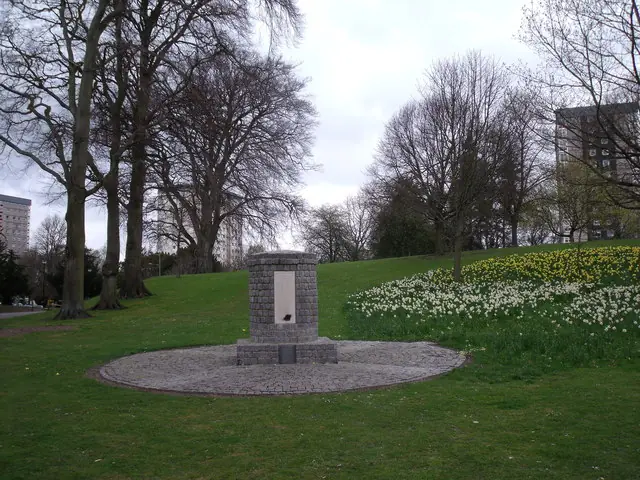
Battle of Falkirk: Wallace Defeated — Falkirk, Scotland
Image: Mike Young · Public domain

William Wallace had been winning. For three years after Stirling Bridge in 1297, the Scottish knight had harried English forces, burned supply lines, and held the north. By the summer of 1298, Edward I—the man who had conquered Wales and earned the nickname "Hammer of the Scots"—had finally had enough. He assembled an army of around 2,000 cavalry and 12,500 foot soldiers and marched north to end this rebellion once and for all.

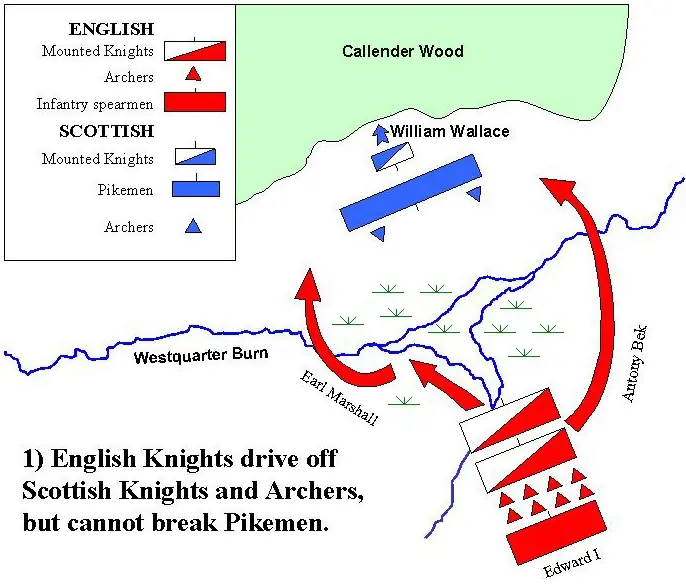
On the morning of July 22, the two armies found each other near Falkirk, about twenty miles west of Edinburgh. Wallace had perhaps 6,000 men, mostly infantry with spears—the schiltrom, a tight bristling circle that had worked brilliantly against cavalry at Stirling. The English had something Wallace did not: a cavalry force that was essentially the medieval equivalent of an armored tank battalion, and a commander who knew exactly how to use it.

The ground was marshy. The Scottish spearmen were positioned on a slope. For a moment, the outcome looked uncertain—the same uncertainty that had hung over Scotland for the past year, the pause before a punch lands.

Battle of Falkirk: Wallace Defeated — Falkirk, Scotland
Image: Mike Young · Public domain

Then it landed.

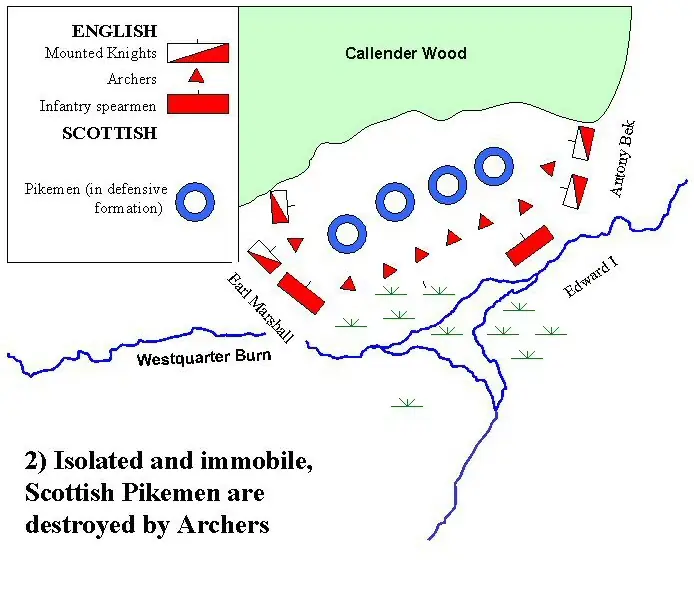
Edward's archers—and he had brought many—began firing. The arrows came in waves, thousands of them, and the Scots had no archers of comparable skill to answer back. This is the detail most people forget: it wasn't the cavalry charge that broke Wallace's army. It was arrows. Lots of them. As gaps opened in the schiltron, the English knights rode through. What followed was less a battle than a collapse. The Scottish infantry scattered. Somewhere between 1,000 and 2,000 of them died. Wallace himself escaped, vanishing into the hills.

Battle of Falkirk: Wallace Defeated — Falkirk, Scotland
Image: Tom Sargent · CC BY-SA 2.0

He would be captured and executed five years later in London, hanged, drawn, and quartered in the manner reserved for traitors. But that came later. What mattered on July 22 was that the moment had passed. The rebellion Wallace had sparked didn't die—Robert the Bruce would reignite it within a decade—but Wallace's particular moment of ascendancy was over. A single afternoon had reversed three years of momentum.

What's remarkable is how thoroughly Falkirk was forgotten in Scottish memory. Wallace became a legend; Falkirk became a footnote. The Scots rewrote their own story, emphasizing Bannockburn in 1314, where they would defeat an English king. But Bannockburn happened because Falkirk had already happened. Bruce learned what Wallace learned that day: you cannot beat English cavalry with spearmen alone. You need terrain, you need archers, you need luck. You need to be smarter than they are, because they have more men and better horses.

Wallace's defeat was thorough, but it wasn't final. That's the strange mercy of history: sometimes you lose the battle and win the war anyway, just by refusing to stay defeated. The Scots would have their independence. They just had to wait for better generals, better tactics, and a king who understood that victory sometimes meant knowing when not to fight.

Source: en.wikipedia.org/wiki/Battle of Falkirk (1298)

Use the arrow keys to move between days

Browse the full archive →