
Daily History
War & conflict

Srebrenica Falls; 8,000 Slain in Genocide

Srebrenica, Bosnia and Herzegovina

Srebrenica Falls; 8,000 Slain in Genocide — Srebrenica, Bosnia and Herzegovina
Image: Michael Büker · CC BY-SA 3.0

The town Srebrenica was supposed to be untouchable. In 1993, the United Nations drew a circle around it, declared it a "safe area," and stationed Dutch peacekeepers on the perimeter to guard 36,000 Bosniak Muslims who had crowded inside. The promise was explicit: you are protected. What happened next was the slow dismantling of that promise, one starving month at a time.

By July 1995, the enclave had been under siege for nearly three years. Bosnian Serb forces under General Ratko Mladić had drawn the noose so tight that children were born and grew old enough to walk without ever having left the town. Bread was rationed. Fuel disappeared. People burned books and furniture to stay warm. The Dutch battalion, officially there to protect the zone, held their position and documented the suffering with professional precision but could not stop it. They were peacekeepers in name only; the peace they were supposed to keep had already broken down years before they arrived.

When Mladić's forces finally pushed into Srebrenica on July 11, the enclave collapsed not with resistance but with panic. The Dutch, 400 soldiers facing several thousand Serb fighters, withdrew. They did what they could—some troops provided covering fire as people fled toward the forests. Most didn't make it. Of approximately 8,000 Bosniak men and boys who scattered into the woods trying to reach Muslim-held territory, more than 7,000 were captured, killed, and buried in mass graves discovered years later.
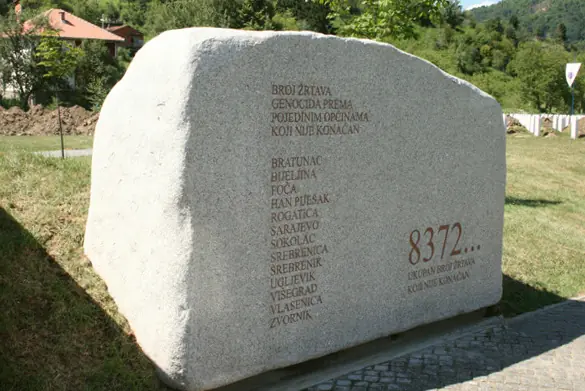
Srebrenica Falls; 8,000 Slain in Genocide — Srebrenica, Bosnia and Herzegovina
Image: Wikimedia Commons · CC BY-SA 3.0

The massacre itself wasn't quick. It unfolded across days in detention centers and warehouse compounds. Men were separated from their families at collection points, loaded onto buses, driven to locations with names like Pilica and Branjevo Farm, and executed. Soldiers filmed some of it. The scale was almost bureaucratic—organized enough that survivors could describe patterns, routes, the names of perpetrators. One execution site held 1,500 bodies. Another held 1,000.

What makes Srebrenica distinct in the cascade of Balkan atrocities is this: it happened under the watch of international peacekeepers. Not in some forgotten corner but in a town the world had promised to protect, with observers present. The Dutch soldiers knew the enclave was collapsing. Their commanders had warned that they couldn't hold it. The warning was treated as information, not as grounds to call for reinforcement or evacuation. So 36,000 people remained inside a circle that was supposed to keep them safe, and then the circle opened.
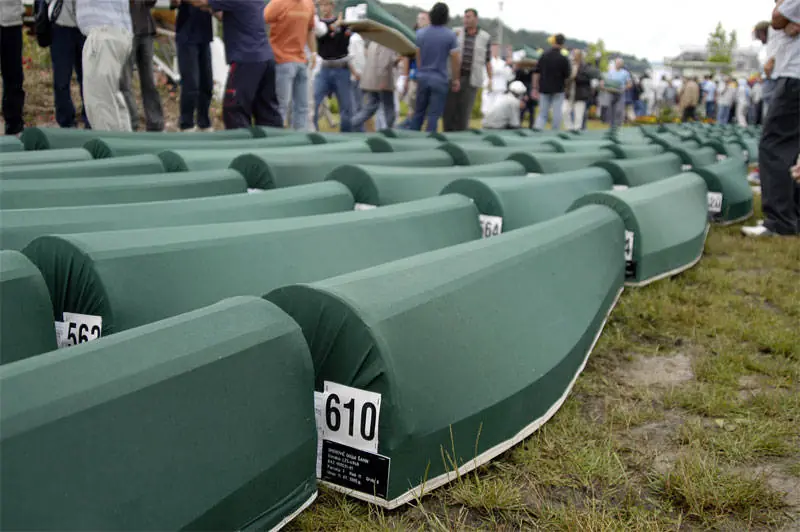
Srebrenica Falls; 8,000 Slain in Genocide — Srebrenica, Bosnia and Herzegovina
Image: User:Emir Arven · CC BY-SA 3.0

Mladić was never tried for the massacre itself. The tribunal convicted him of genocide for ordering it, which carries its own gravity. He lived under an assumed name in a Belgrade suburb for 16 years before his arrest in 2011. He had to be found on a street, like anyone else.
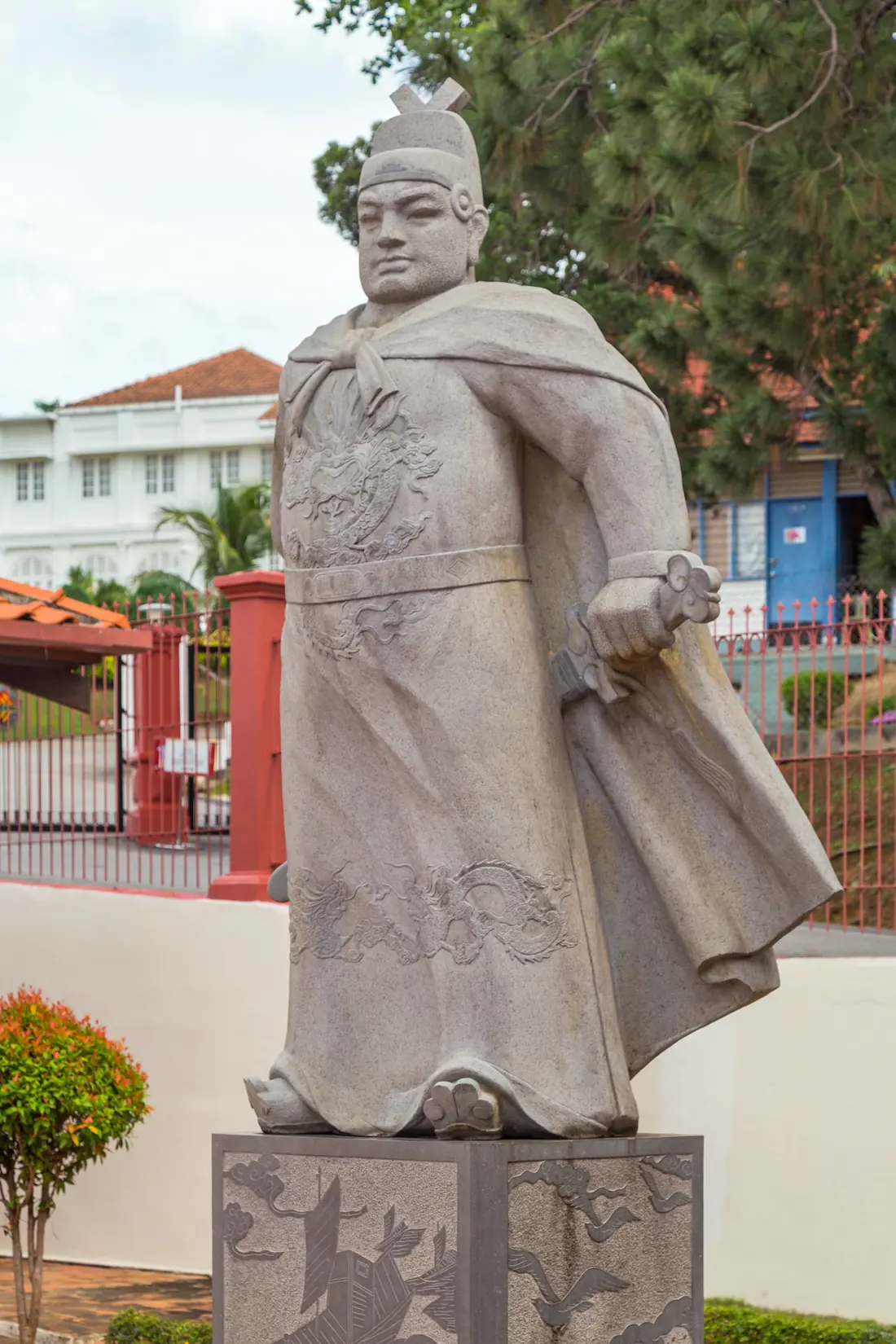

Source: en.wikipedia.org/wiki/Srebrenica massacre

Exploration

Zheng He Embarks on First Treasure Voyage

Nanjing, China

Zheng He Embarks on First Treasure Voyage — Nanjing, China
Image: Marcin Konsek · CC BY-SA 4.0

The largest ship Zheng He commanded could hold forty European caravels on its deck and still have room left for the admiral's garden. A man who had been born under Mongol rule, raised Muslim, now elevated and castrated in the service of empire, stood at Nanjing's docks in the summer of 1405 and watched his fleet spread across the harbor like a city abandoning itself into islands. The sheer enumeration of it still seems designed to provoke doubt: 317 vessels. Seventy treasure ships, some possibly exceeding 400 feet in length—though historians still argue the exact dimensions, as if precision could render the thing less impossible. Nearly 28,000 people. Sailors, soldiers, merchants, astronomers, translators, bureaucrats, all coordinated to move together across an ocean nobody in Europe had seriously considered crossing. The Ming Dynasty had decided to demonstrate what power looked like when you stopped defending walls and pointed yourself instead toward the horizon.

Before that dock in Nanjing, this was unimaginable outside the daydreams of a small minority. The Mediterranean had its routes, its merchant traditions, its individual daring souls. But nothing resembling the engineering, coordination, and sheer administrative will required to move this many people this distance with this much intentionality. Europeans were still in the age of coastal hugging and accidents. Zheng He didn't hug a coastline. He crossed an ocean like he owned it because his emperor had told him he did.

For nearly three decades, he did own it. The voyages reached Aden and pushed down the African coast. He returned with ambassadors and gifts—giraffes, lions, zebras, ostriches—living proof that beyond the mapped world, other kingdoms existed and were willing to acknowledge the Ming as something extraordinary. He collected astronomical observations. He established trading protocols. He left monuments with inscriptions in Arabic and Chinese announcing imperial power to anyone who could read.

When Columbus sailed in 1492, Zheng He had been dead for sixty years. The knowledge of what had been accomplished, what was possible, had been systematically erased. The Ming court had decided the voyages were too expensive, too distracting, too much a drain on resources better spent on internal security. The records were ordered destroyed. The maps were lost or deliberately hidden. By the time European ships began asking questions in the Indian Ocean—"Who has been here?"—the answer they received was silence.

Zheng He Embarks on First Treasure Voyage — Nanjing, China
Image: User:Vmenkov · CC BY-SA 3.0

This is where the story bends into something stranger than any single voyage could be. China didn't fail at oceanic exploration. China succeeded completely and then chose to stop. The technology existed. The knowledge existed. The desire to demonstrate power existed. What didn't exist, at the crucial moment, was the appetite to continue. The court turned inward. Buddhism and Confucianism reshaped priorities. A decision was made—deliberate, complete, documented in archives that would outlive the memory of it—to cease.

Europe inherited an ocean that China had already mastered and then abandoned like a game no longer worth playing. The Portuguese would cautiously, methodically work their way down African coasts in the coming decades, each captain inching forward as if charting entirely new territory, never knowing that an entire empire had already been there, had already left monuments, had already proven the route, and had already decided it was too expensive to defend.

Source: en.wikipedia.org/wiki/Zheng He

Use the arrow keys to move between days

Browse the full archive →